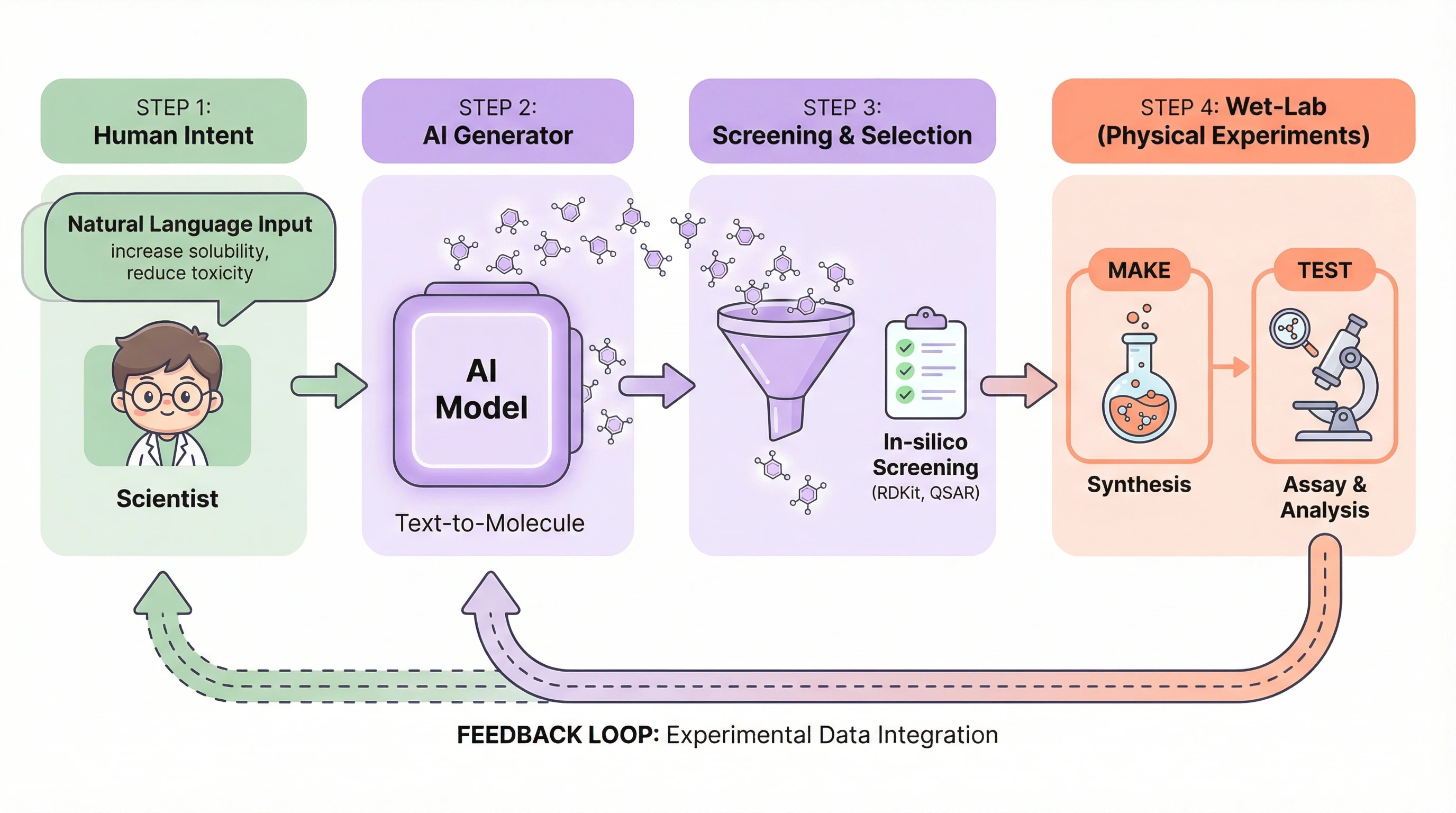
LexiChem starts from a natural-language description of a molecule, generates candidate structures, and checks them with RDKit for 2D/3D exploration. I built the data pipeline, ran model experiments and ablations, and brought inference into the product.
Local capstone demo · 1 min 47 sec. Dashboard, Experiments and Simulation are working; RAG/Knowledge is still in development.
Overview
LexiChem turns a natural-language molecule description into a structure that can be viewed, checked and explored further. Rather than stopping at a model demo, our three-person team built the full flow into an application: enter a brief, generate candidates, validate structures with RDKit, compare results and revisit earlier experiments.
I focused on the AI data pipeline, SMILES/SELFIES conversion, method development, ablations and the inference path between the model and backend. The interface and product workflows were shared across the team.
How it works
01Description
02Model inference
03Molecular structure
042D / 3D exploration
LexiChem handles generation and computational exploration. Laboratory synthesis and testing come next, outside the application. Select the image to enlarge.
From research to product
The application has four areas: Dashboard, Experiments, Simulation and Knowledge. In the broader capstone project, we conducted experiments on Mol-Instructions, L+M-24 and ChEBI-20. The APWeb-WAIM paper focuses on the core method of aligning text and SELFIES representations in a shared latent space, evaluated on the L+M-24 benchmark.
LexiChem supports early, computational exploration of molecular candidates. Biological activity and synthesis feasibility still need experimental validation in the laboratory.
What I built
On the research side, I developed method ideas and tested them through experiments and ablations. I wrote the Introduction and the full Results & Discussion, and co-wrote Methods with a teammate.
For the data pipeline, I processed Mol-Instructions, L+M-24 and ChEBI-20; used RDKit to parse structures, check valence and canonicalize SMILES; removed duplicates; then converted the remaining structures to SELFIES for training.
On the product side, I connected Experiments to the backend. The flow normalizes the prompt, calls models through FastAPI and Triton, checks returned SMILES with RDKit and saves each run to MongoDB. The rest of the application was built with the team.
The product in use
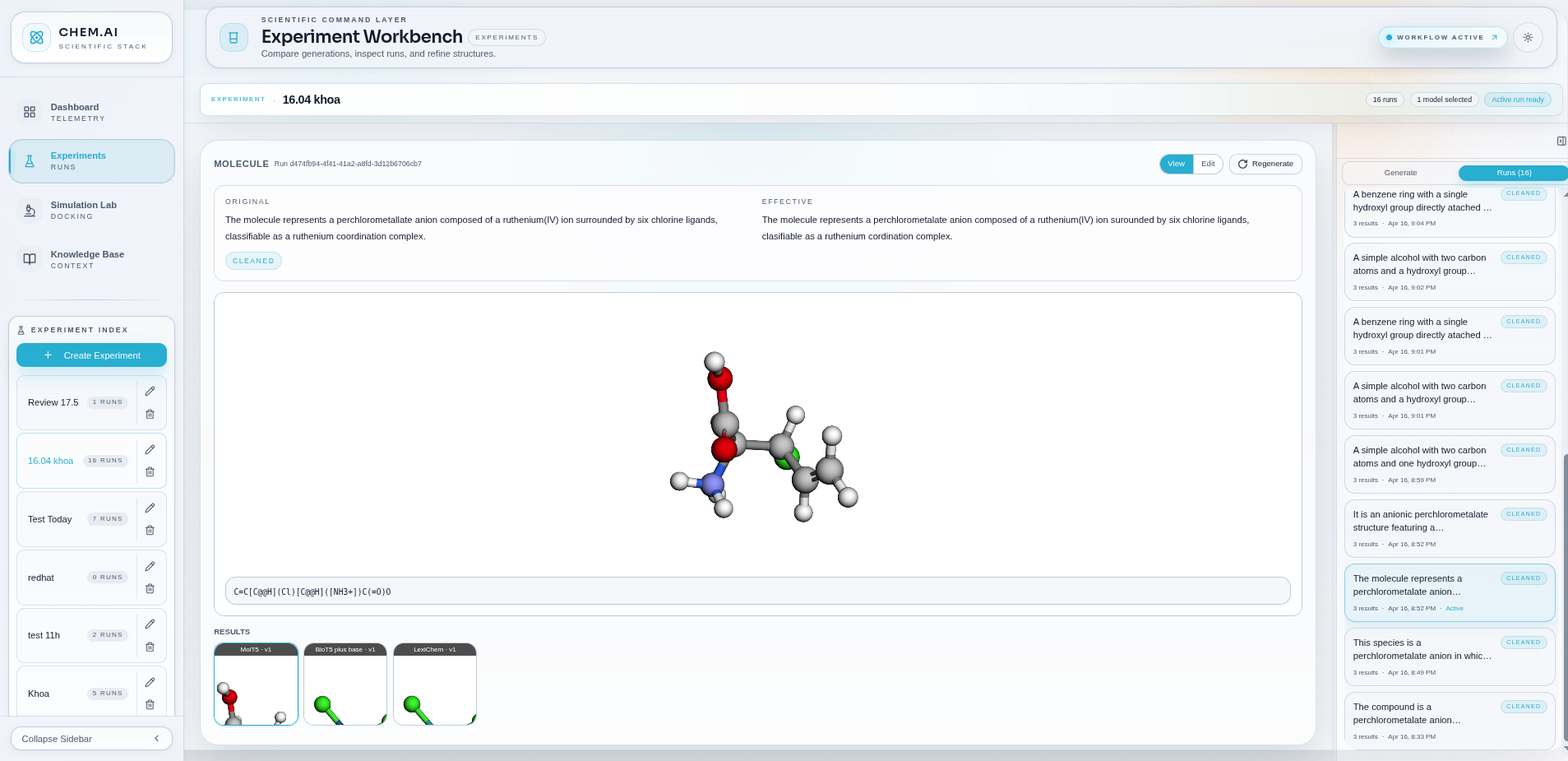
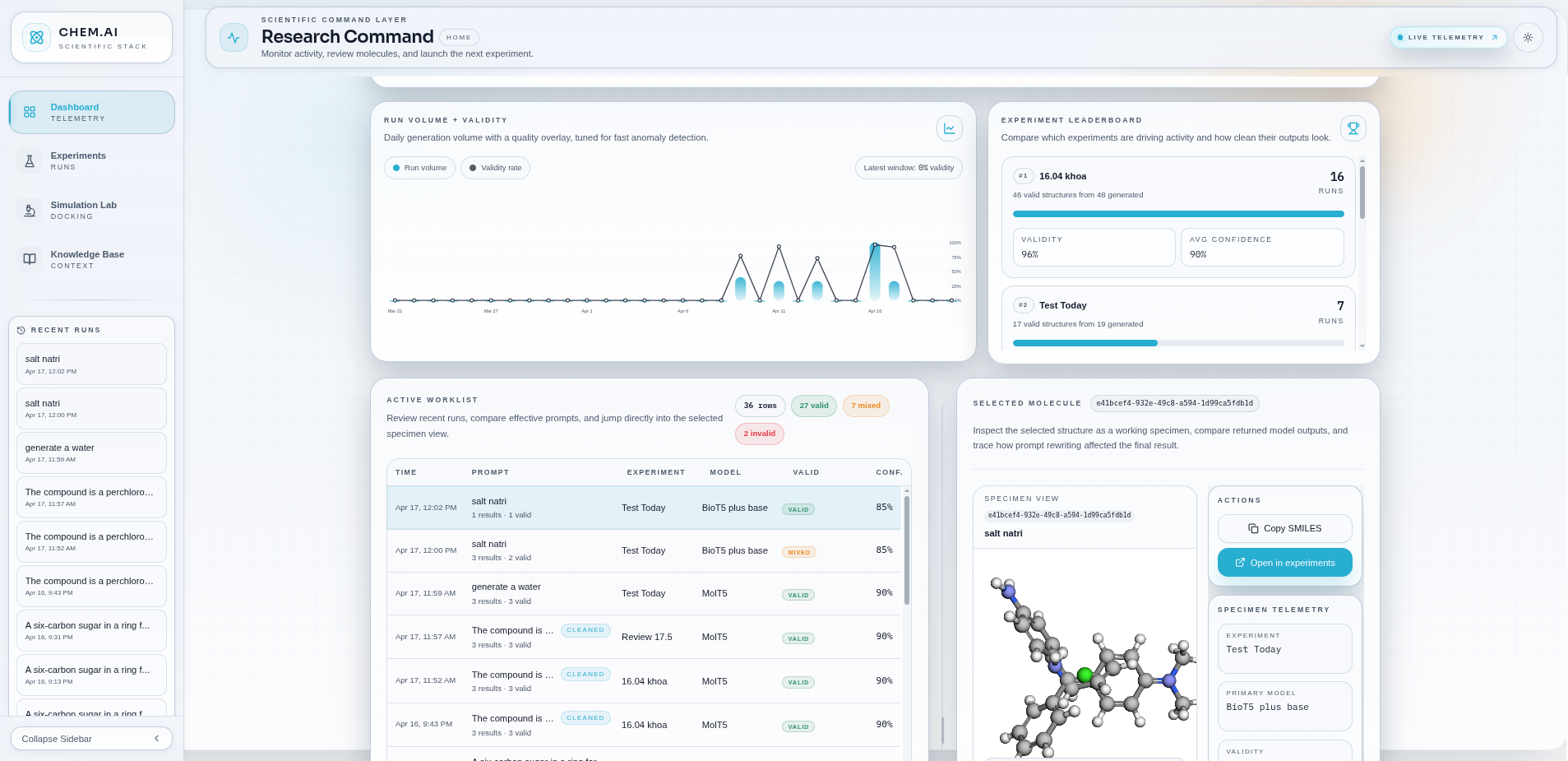
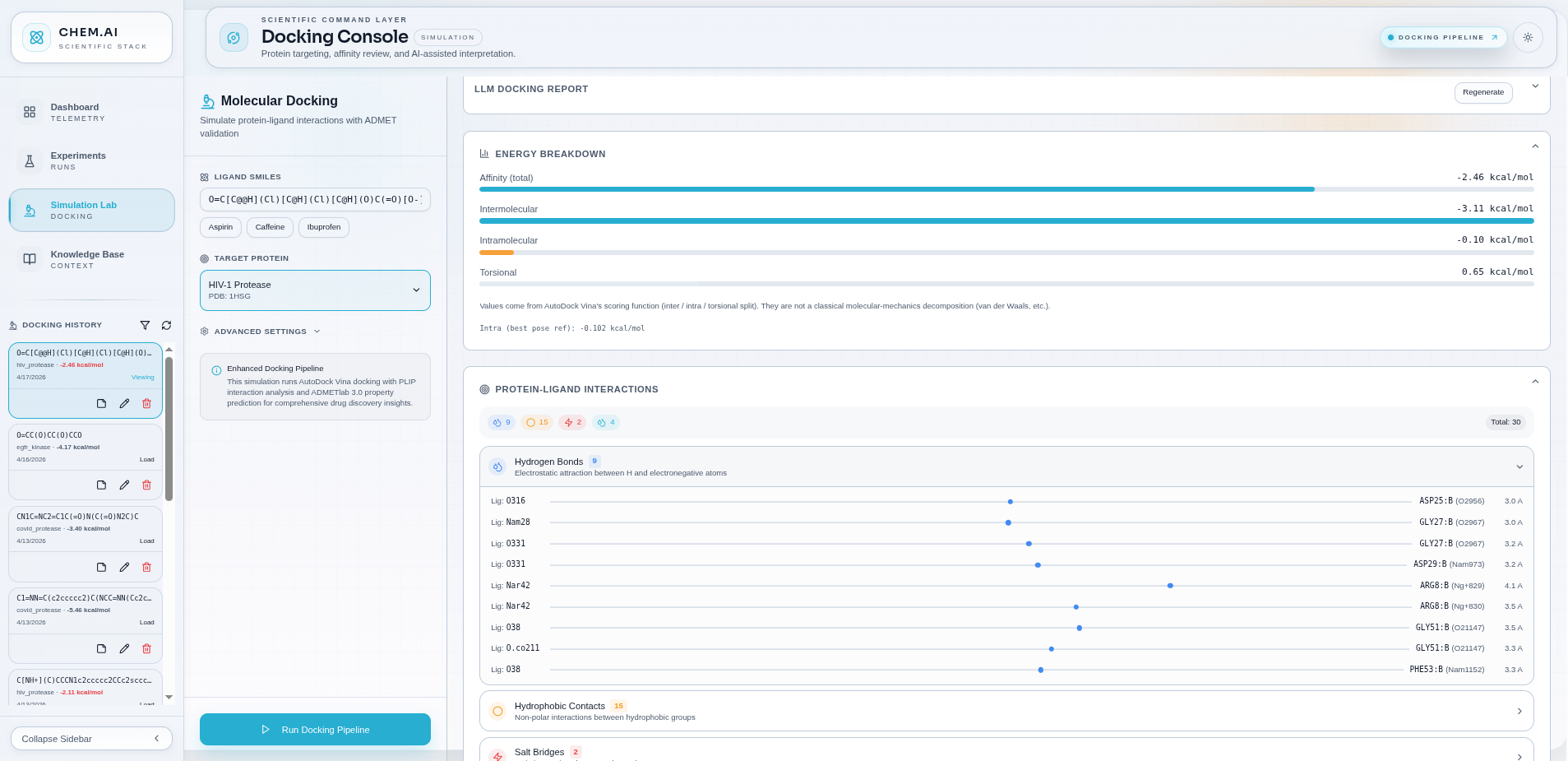
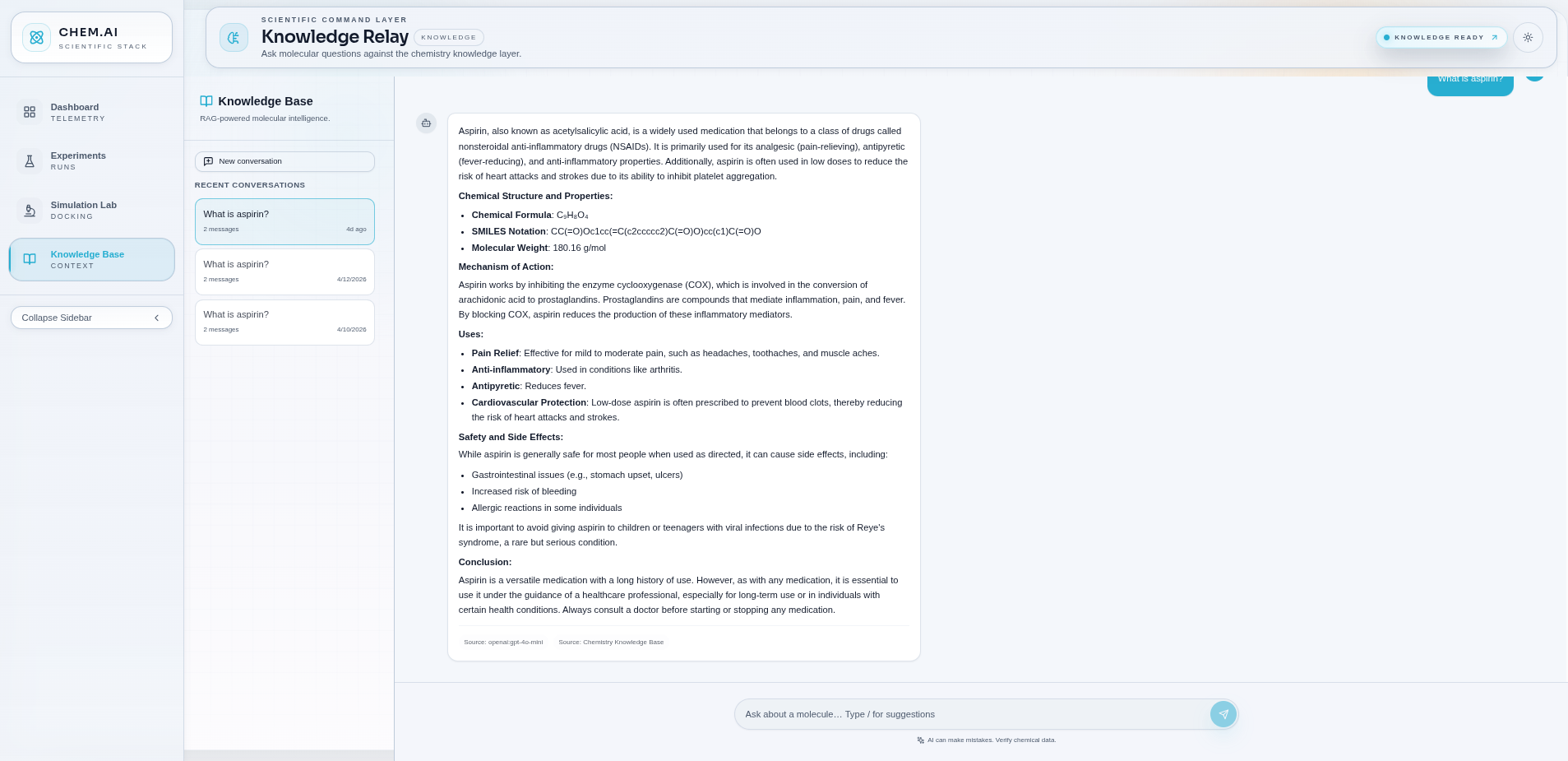
The screenshots and video below come from the locally running capstone build. Dashboard, Experiments and Simulation work; RAG/Knowledge remains in development. Numbers visible in the screenshots capture the demo state, not independent benchmark results.
Experiments Workbench · comparing prompts and results across models.Dashboard · run history and the currently selected molecule.Simulation · exploring a ligand, target protein and their interactions.Knowledge · interface for the RAG/Knowledge area in development.
Research connection
ConferenceAPWeb-WAIM · 2026Accepted
LexiChem: Shared-Latent Alignment for Faithful Text-to-Molecule Generation in SELFIES Space
Khoa Minh Nguyen, Nam Van Hai Phan, Phu Trong Nguyen, Duc Tai Phan, Tri Minh Pham, Duc Ngoc Minh Dang
APWeb-WAIM Joint International Conference on Web and Big Data
First author
Shared-latent text and SELFIES alignment for text-to-molecule generation evaluated on L+M-24, derived from the core research of our capstone project.
@inproceedings{lexichem2026,
  title = {LexiChem: Shared-Latent Alignment for Faithful Text-to-Molecule Generation in SELFIES Space},
  author = {Khoa Minh Nguyen and Nam Van Hai Phan and Phu Trong Nguyen and Duc Tai Phan and Tri Minh Pham and Duc Ngoc Minh Dang},
  booktitle = {APWeb-WAIM Joint International Conference on Web and Big Data},
  year = {2026},
  note = {Accepted; final publication metadata pending}
}
Nam Van Hai Phan, Khoa Minh Nguyen, Ngoc Thien Phu Nguyen, Nguyen Doan Hieu Nguyen, Tri Minh Pham, Duc Ngoc Minh Dang
International Conference on Computational Intelligence in Engineering Science
Co-first author
Contrastive representation alignment of textual and molecular embeddings on BioT5+, reporting 69.77% BLEU and 31.28% Levenshtein distance on the L+M-24 benchmark.
We introduce ChemAligner-T5, a BioT5+ base model enhanced with a contrastive learning mechanism to directly align textual and molecular representations.
@inproceedings{chemalignert52026,
  title = {ChemAligner-T5: A Unified Text-to-Molecule Model via Representation Alignment},
  author = {Nam Van Hai Phan and Khoa Minh Nguyen and Ngoc Thien Phu Nguyen and Nguyen Doan Hieu Nguyen and Tri Minh Pham and Duc Ngoc Minh Dang},
  booktitle = {International Conference on Computational Intelligence in Engineering Science},
  year = {2026},
  doi = {10.1007/978-3-032-21625-0_16}
}