
Mask CoMER
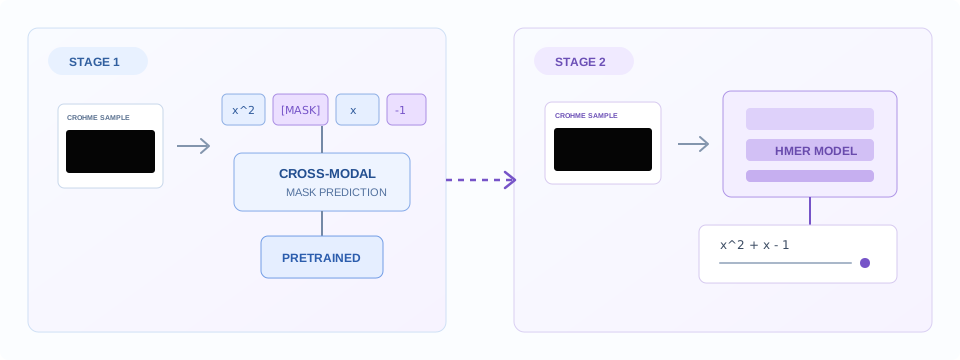
A two-stage strategy: masked-language pretraining first, then the main HMER task with stochastic-depth regularization.
Handwritten mathematical expression recognition
Research on converting handwritten mathematical expressions into structured sequences, including experiments in masked-language pretraining and multi-task learning.
From handwritten mathematics to structured LaTeX sequences.
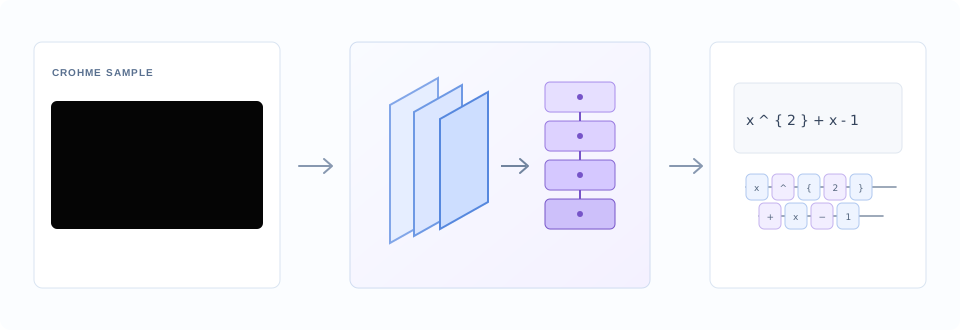
* Sample from CROHME 2016 dataset. (Source)
Handwritten Mathematical Expression Recognition turns an image of handwritten mathematics into a structured sequence. Beyond reading individual symbols, the model must parse two-dimensional spatial layouts like fractions, superscripts, subscripts, and roots.
Implemented Mask CoMER methods and contributed baseline reproduction, ablations, error analysis and paper writing; contributed multi-task learning experiments to MTL + CBARM.
Trained and evaluated PyTorch models, with experiment runs tracked in Weights & Biases.
One recognition pipeline, with two complementary research interventions aimed at preserving context and mathematical structure.
A grayscale image contains symbols and two-dimensional layout.
The encoder converts the image into spatial visual features.
The decoder uses visual context to generate a structured token sequence.
The sequence can be reconstructed as a mathematical expression.
A two-stage strategy: masked-language pretraining first, then the main HMER task with stochastic-depth regularization.
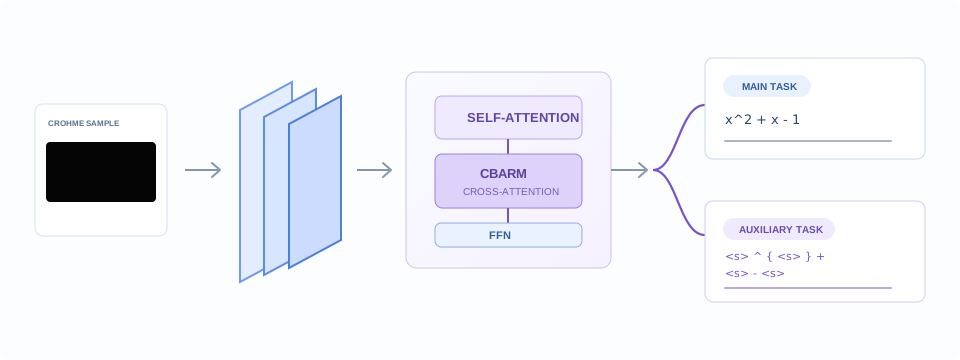
The main LaTeX-sequence task is trained alongside a structural auxiliary task, while CBARM refines cross-attention using channel and spatial cues.
International Conference on Document Analysis and Recognition
Masked-language pretraining and stochastic-depth regularization for HMER, achieving up to +5 ExpRate points over CoMER on CROHME.
Excerpt from the abstract
We propose Mask CoMER, a two-stage training approach that combines a novel Masked Language Model Pretraining objective with stochastic depth regularization.Read the full abstract at source@inproceedings{maskcomer2025,
title = {Mask CoMER: Enhancing Handwritten Mathematical Expression Recognition with Masked Language Pretraining and Regularization},
author = {Nam Van Hai Phan and Khoa Minh Nguyen and Trung Thanh Nguyen and Trung Thanh Pham and Phuong-Nam Tran and Duc Ngoc Minh Dang},
booktitle = {International Conference on Document Analysis and Recognition},
year = {2025},
doi = {10.1007/978-3-032-04624-6_22}
}Journal of Information and Telecommunication
Multi-task learning framework with convolutional block attention refinement module (CBARM) for handwritten mathematical expression recognition, published online 19 August 2026.
Excerpt from the abstract
Handwritten Mathematical Expression Recognition (HMER) is challenging due to complex structural relationships, implicit symbols, and variations in handwriting styles.Read the full abstract at source@article{mtlcbarmhmer2026,
title = {Enhancing handwritten mathematical expression recognition with convolutional block attention refinement module and multi-task learning},
author = {Thanh Trung Nguyen and Nhut Minh Nguyen and Nam Van Hai Phan and Khoa Minh Nguyen and Trung Thanh Pham and Phuong-Nam Tran and Cuong Tuan Nguyen and Duc Ngoc Minh Dang},
journal = {Journal of Information and Telecommunication},
year = {2026},
doi = {10.1080/24751839.2026.2716432},
note = {Published online 19 August 2026; final issue metadata pending}
}The HMER research record includes Mask CoMER, published at ICDAR 2025, and a Journal of Information and Telecommunication paper published online on 19 August 2026. The publication entries below give the authorship, venue and status for each paper.